




Hanukkah, Oh Chanukah, Come light the menorah …
The truth you need to know about the most well known of Jewish holidays
Because of its proximity to Christmas, Chanukah is among the best known of Jewish holidays. But how and why it is celebrated continues to be a mystery to many. Our goal today is to “shatter the myths” around Hanukkah.
Below, we answer a few of the most frequently asked questions about Hanukkah (or Chanukah or Hanukah or Chanuka. Yes, we will get to those pesky multiple spellings … keep reading.) Every year we post this article with some edits and updates, so if feels familiar to some readers, it very well may be.
Since it’s our job to give our readers accurate information, we will actually help everyone out with the dates of Chanukah in 2026.
Hanukkah, the Jewish Festival of Lights, starts the night of Friday, Dec. 4, 2026. The eighth and final candle will be lit the night of Friday, Dec. 11, 2026.
(And if you are in the Champaign-Urbana area, check out our “how to celebrate Chanukah in Champaign-Urbana” if you are looking for resources and events).
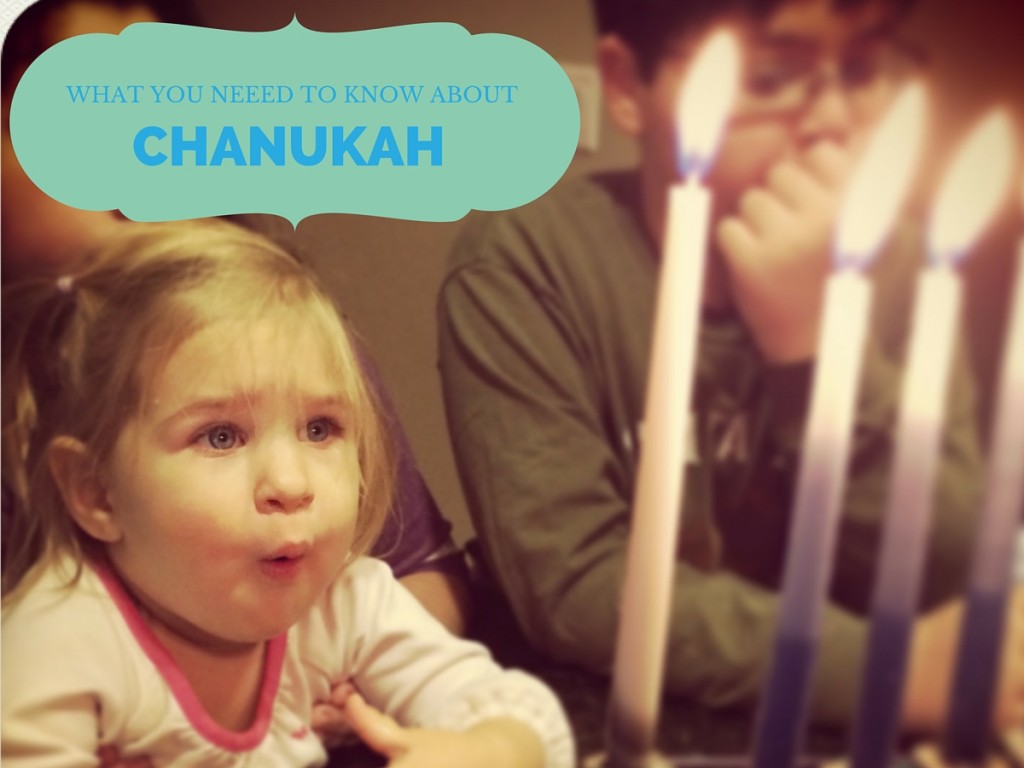
Hanukkah may be one of the most well-known Jewish holidays, but it is hardly the most religiously significant.
Hanukkah celebrates the aftermath of a military victory by Jews (the Maccabees) who fought the religious oppression of Assyrian rule more than 2200 years ago.
The Jews took back the holy Temple in Jerusalem, which had been desecrated by the Assyrians, who had used it to worship idols and allowed farm animals to reside there.
Hanukkah celebrates a miracle — when the Maccabees wanted to light the menorah as part of the re-dedication of the holy temple, they could only find a tiny flask of oil, enough to light it for only one day.
As the story goes, a miracle happened when the oil actually lasted for eight days. (Think of it this way: it would be as if your phone was on 10 percent and you had no charger, but it stayed on for eight days!)
While the message of Hanukkah is a beautiful one — one that celebrates faith, miracles, and dedication to our people and our traditions — the story is not found in Jewish scripture.

Work doesn’t stop on Hanukkah, nor do other regular activities.
- Unlike some Jewish holidays, we don’t take any time off work or school for Hanukkah observances.
- The main religious observance for Chanukah is lighting candles on the Hanukkah menorah each night, generally in the home. For many, it’s customary to put a lit menorah in the window so everyone can see it.
- There are not special services added to the religious calendar for Hanukkah.
A Hanukkah menorah has nine branches: one for each night, as well as a “helper” candle called the shamash that lights the other candles (see the photo below — the shamash is the one set apart from the other eight).
Since we don’t have family locally, sometimes we bridge the distance during Hanukkah by singing candle lighting blessings over FaceTime with grandparents, aunts and uncles, and/or cousins.
In addition to candle lighting, celebrations usually consist of latke eating, playing games such as dreidel, singing songs, and gift exchanges.
My personal favorite modern Hanukkah song is the late Debbie Friedman’s “I am a Latke,” which tells the story of a potato waiting to be made into a latke. If you want to hear it, head to YouTube. Warning: will get stuck in your head.
Most years, we routinely get asked if our family will go “home” for Hanukkah. We generally reserve those trips for the “major” religious Jewish holidays such as Rosh Hashanah and Passover.

Yes, some people give gifts on Hanukkah, but there is no one way to do it.
Presents were not part of the Hanukkah tradition until very recently, and mostly it is an American construct. Probably the biggest myth about Hanukkah is that everyone gets eight presents — one every night. Traditionally, children receive money for Hanukkah, called “gelt.” Gelt also comes more commonly as chocolate coins, and children often use the chocolate coins as part of the dreidel game.
Every family has its own Hanukkah gift-giving traditions. When I was growing up, I got a gift just about every night, but they weren’t all from my parents — one night the siblings would exchange gifts, the next night we would receive gifts from grandparents, etc.
In our family, gift giving is centered around children. Other families might include adults in gift-giving traditions (or do some variation of a white elephant exchange).
There is no one way to gift at Hanukkah.
The dates we celebrate Hanukkah never change.

Yep, it’s true — Hanukkah always starts on the 25th of the Hebrew month of Kislev, but because the Hebrew calendar is based on a lunar calendar, the “English” date changes every year.
There is not one “true” English spelling of the holiday’s name.
The name is a Hebrew word, meaning dedication, that has been transliterated into English. That’s why you’ll see the various spellings — Chanukah/Hanukkah/Hanukah/Chanuka/Hanukka.
It is Associated Press newspaper style to spell it “Hanukkah,” which often is seen in the press; I prefer “Chanukah.”
In Hebrew, there’s only ONE way to spell it!

So, what’s a dreidel? And why does it spin?
One myth we are going to bust here: Jews rarely play with a dreidel made out of clay. Yes, the song says when it’s dry and ready, oh dreidel I shall play. The reality is that a dreidel made of clay is really hard to spin. These days, most dreidels are made out of wood or plastic.
Dreidel may seem to be a silly game that is frankly all about gambling chocolate (or money). The game was adapted from other European cultures and incorporated into the Chanukah tradition as a way to teach children the holiday’s meaning, which has evolved over time. The message of the letters: “A great miracle happened there.”
We get to eat foods fried in oil on Hanukkah — and they have zero calories (hahaha).
Part of celebrating Chanukah customarily means eating latkes and other foods fried in oil, to remind us of the miracle of the oil lasting eight days. And it’s a Hanukkah miracle that they have zero calories! (OK, that’s the fake news portion of this story – we just wanted to make sure you were still paying attention.)
And let me just say that latkes are not potato pancakes — they’re much better! Here’s a good latke recipe complete with a video. Warning: your house might smell for days.

Jelly donuts (called sufganiyot) are very popular in Israel and other parts of the Jewish world — occasionally they can be found locally. If you want to try your hand making them at home, here’s a sufganiyot recipe that we’ve heard is delicious.
(Disclaimer: these are my opinions. Some might disagree.) Happy Hanukkah to all who celebrate!
Laura Weisskopf Bleill is the co-founder and editor of chambanamoms.com. You can reach her at laura@chambanamoms(dot)com.
Looking for more? Subscribe to our email newsletter. Want more ideas for holiday (or everyday) fun? Check out our Event Calendar.
Everything Holiday Season In and Around Champaign-Urbana
- What You Need to Know About Chanukah
- Where to Eat Dinner on Thanksgiving in Champaign-Urbana
- Where To Buy Toys in Champaign-Urbana
- 10+ Things to Do in Chicago this Holiday Season
- 10+ Things to Do in Indianapolis this Holiday Season
- Holiday Parades and Tree Lightings in the Champaign-Urbana Area
- Zoo Lights: Find them in Bloomington, Chicago, Indianapolis and Saint Louis
- 35+ Ways to have Holiday Season Fun on a Budget in Champaign-Urbana
- Where to Find Santa Claus in the Champaign-Urbana Area
- Where to Buy a Live Christmas Tree Near Champaign-Urbana
- Champaign-Urbana Area Christmas Shows, Concerts, Performances and More
- 10 Great Places to See Holiday Lights in Central Illinois
- Night Lights Return to Lake of the Woods Botanical Garden
- Where to Order a Thanksgiving Turkey in Champaign-Urbana
- Lights to Illuminate Prairie Farm Again this Holiday Season
- Holiday Glow Returning to Allerton Park in 2026
